
Reptilia
 Go to Database
 We revised the literature in the several journal listed below. A summary of many of the topics and ideas covered in the literature is presented in Delfino and Sánchez-Villagra (2010), the abstract of which reads as follows:
'Given the large diversity and long stratigraphical range of fossil reptiles, their development is a fundamental aspect of the evolution of ontogeny in vertebrates. Eggs, juveniles, embryos and growth series document different aspects of fossilised ontogenies. About three fifths of the more than 850 available publications on these topics concern dinosaurs. Non-invasive imaging techniques have facilitated the study of embryos in ovo. Examination of ontogenetic trajectories is used to establish criteria to identify fossil growth series and solve taxonomic issues. Many morphological innovations in reptilian skeletal structures are associated with growth heterochronic changes, whereas sequence heterochronic changes remain largely unstudied but are a potential avenue of research. Relative age assessments via not only palaeohistology but also comparative anatomy has been used to reconstruct life history patterns in fossil archosaurs. Several fossil marine reptiles evolved viviparity convergently. Extinct adult phenotypes can reveal information on development, as in the discovery of polydactyly in diapsids, the examination of vertebral number evolution, and its relation to somitgenesis and Hox-gene boundaries, and signs of tissue regeneration provided by anatomical peculiarities following caudal autotomy.'
From: Delfino M, Sánchez-Villagra MR. 2010. A survey of the rock record of reptilian ontogeny. In: Developmental Vertebrate Palaeontology (ed Sánchez-Villagra MR). Seminars in Cell and Developmental Biology 21:432-440. 
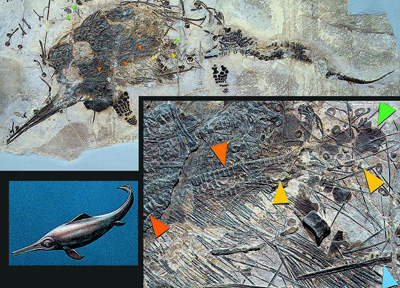
The ichthyosaur Mixosaurus cornalianus from the middle Triassic UNESCO site of Monte San Giorgio in Switzerland (see Brinkmann 1996). Depicted is a female containing parts of embryos, including mandibular (blue), pectoral girdle (green), and vertebral (orange and yellow) parts. Reconstruction by Beat Scheffold. Photos Copyright of the PIMUZ.
We revised the following 16 Journals devoted to palaeontology (range indicated) and six other journals containing works on fossils. We also include in the database references from other sources that were drawn to our attention. This review extended to issues available to us until August 2009 and is being updated on an irregular basis.
- Acta Palaeontologica Polonica (all volumes)
- Annales de Paléontologie (1998-2009)
- Comptes Rendus Palevol (all volumes)
- Cretaceous Research (all volumes)
- Geobios (all volumes)
- Journal of African Earth Sciences (all volumes)
- Journal of Paleontology (all volumes)
- Journal of South American Earth Sciences (all volumes)
- Journal of Vertebrate Paleontology (all volumes)
- Palaeobiology (1999-2009)
- Palaeogeography, Palaeoclimatology, Palaeoecology (all volumes)
- Palaeontological Research (2003-2009)
- Palaeontology (all volumes)
- Palaios (2000-2009)
- Palaeoworld (2006-2009)
- Vertebrata palasiatica (2001-2009)
- American Museum Novitates (all volumes)
- Bulletin of the American Museum of Natural History (all volumes)
- Comptes Rendus de l'Académie des Sciences - Series IIA - Earth and Planetary Science (1997-2001-Comptes Rendus Palevol)
- Nature (all volumes)
- Naturwissenschaften (all volumes)
- Science (all volumes)